Wollmatten and the Floor Covering I Almost Didn’t Buy.
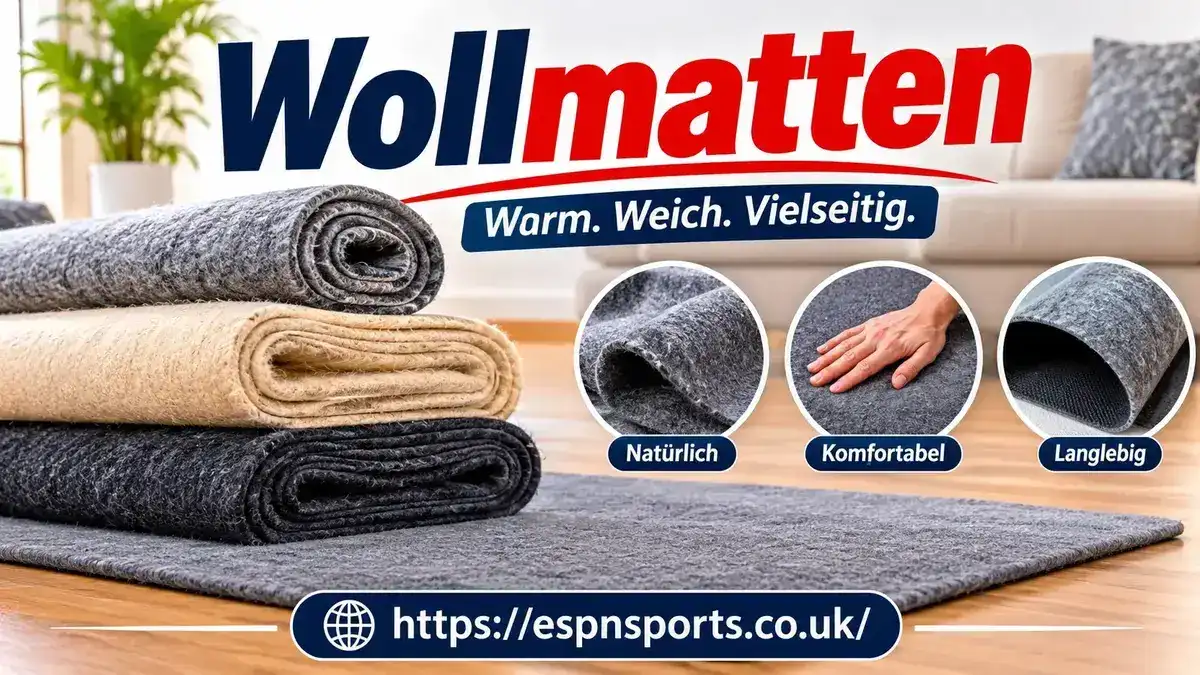
I was standing in my neighbour’s kitchen — a woman who grew up outside Stuttgart and has lived on our street for roughly fifteen years — and I noticed the floor felt different under my bare feet. Not cold. Not hard. There was a subtle give to it, a warmth that didn’t match the stone tiles I could see around the edges of the room.
I asked her what was under my feet. She said, in her slightly clipped English, “Wool. It’s a wool mat.” She used the German word — wollmatte — and I filed it away without thinking much more about it.
Three months later, when I was trying to solve the draft problem in my own kitchen, I remembered the word. I typed it into a search bar. And that’s how I ended up here, writing about something I didn’t know existed a year ago.
The Actual Definition (It’s Simpler Than You Think)
Wollmatten is a compound German noun. Wolle is wool. Matten is mats. That’s the entire translation, and I want to get it out of the way early because the word sounds more specialised than the object actually is.
A wollmatte is a flat, dense mat made from sheep’s wool that has been compressed into a solid, usable sheet. That’s it. No hidden technology. No proprietary process. The wool is cleaned, carded, and then either felted — pressed together with heat and moisture until the fibres fuse — or woven on a loom into a tight, low-profile textile. Some industrial versions are needle-punched, which uses thousands of tiny barbed needles to mechanically lock the fibres into a uniform density.
What you end up with is a mat that sits flat, stays put, and feels nothing like the decorative wool rugs you’d find in a furniture showroom. These are functional objects. They’re closer in spirit to a doormat than a Persian carpet, though the material quality is considerably higher than that comparison suggests.
They’ve been standard in German, Austrian, and Swiss homes for generations. Not as a design statement. As a practical solution to cold floors, damp entryways, and drafty rooms. The kind of object that exists because it solves a problem, not because someone decided it would photograph well.
What Makes Wool Unusually Good at Being a Floor
I want to be careful here not to sound like I’m selling you something. Wool is not a miracle material. It has limitations. But the specific combination of properties it brings to a floor covering is genuinely difficult to replicate with synthetic alternatives, and I think it’s worth understanding why.
The key is the fibre structure. Each strand of wool has a natural wave — a crimp — that creates microscopic air pockets within the mat. Those pockets act as insulation, trapping body heat and blocking the cold transfer from the floor below. This is physics, not marketing. The same principle is why sheep survive winters on exposed hillsides without any additional protection.
Wool also handles moisture in a way that most people find counterintuitive. The fibre can absorb roughly a third of its own weight in water vapour without feeling damp to the touch. In a kitchen or hallway, this means that wet shoes and spilled drinks don’t create the soggy, lingering wetness you’d get with cotton or jute. The mat absorbs the moisture, holds it within the fibre structure, and releases it gradually as the air dries.
Then there’s the fire resistance, which I only learned about because I was reading product specifications late one evening and got curious. Wool doesn’t ignite easily. It has a high ignition temperature and tends to self-extinguish when the flame source is removed. The National Institute of Standards and Technology has documented wool’s inherent flame-retardant properties in building material research, noting that it produces less smoke and fewer toxic gases than synthetic alternatives when exposed to fire. No chemical treatment required.
And the acoustic benefit — which was the thing that actually sold me — is significant. Wool fibres absorb sound waves rather than reflecting them. In a room with hard floors and bare walls, laying down a dense wool mat noticeably reduces echo and makes the space feel calmer. I didn’t expect a floor covering to change how a room sounded, but it did.
The Environmental Case, Without the Greenwashing
I’ve grown tired of products that describe themselves as sustainable because they come in a recycled cardboard box. So let me be specific about what’s genuinely true here and what requires more nuance.
The strong points are straightforward. Wool is a renewable protein fibre — sheep grow a new fleece every year, and the shearing process doesn’t harm the animal when done properly. Manufacturing wool into felt or yarn requires a fraction of the energy needed to produce polyester or nylon from petroleum. Wool doesn’t shed microplastics. And at the end of its life, a wool mat decomposes in soil within months, returning nitrogen and other nutrients to the earth rather than persisting in a landfill for centuries.
Many of these mats are also produced from coarser grades of wool that the garment industry rejects. This is a genuine use for a material that would otherwise be wasted, which is a more honest form of sustainability than most of what gets advertised.
The nuance: sheep produce methane, and large-scale grazing operations can degrade land if they’re poorly managed. Shipping wool across oceans adds carbon emissions that partially offset the production advantages. The environmental picture depends heavily on where the wool comes from and how the sheep are raised.
The Ellen MacArthur Foundation has published extensive research on the textile industry’s environmental footprint, and their data consistently shows that natural fibres like wool — particularly when sourced from regenerative farming systems — carry a substantially lower long-term environmental cost than synthetics, even accounting for the methane issue. But “substantially lower” is not “zero impact,” and I think it matters to say that clearly.
If you want the strongest possible sustainability case, look for mats made from locally sourced, undyed wool from farms you can actually research. That version of the product is genuinely hard to fault.
Where I’ve Put Mine (And the One Spot I Wouldn’t)
The practical question is always placement. A wool mat sounds appealing in the abstract, but where does it actually make a measurable difference?
The kitchen. This was my first purchase, driven entirely by the cold tile problem I mentioned earlier. A dense felted mat in front of the sink and stove transformed how the room felt during winter. The insulation is immediate and real. Spills blot out easily thanks to the lanolin in the fibres, and the mat has held up to two years of daily cooking without looking worse for wear.
The hallway. This is where the dirt resistance matters most. Wool’s fibre structure keeps particles on the surface rather than grinding them into the mat, which means a quick vacuum once a week keeps it looking clean. I was sceptical about putting a natural material in the highest-traffic zone of the house, but it’s handled muddy boots and wet umbrellas without any visible damage.
Under the dining table. Chairs scraping across hard floors is one of those sounds that sets my teeth on edge. A wool mat under the table eliminated the noise almost entirely and added a layer of visual warmth to a room that previously felt a bit clinical.
The one spot I’d avoid: directly inside a shower room or anywhere with standing water. Wool handles moisture well, but it’s not waterproof. Constant saturation will eventually break down the fibres and create the conditions for mildew. A small mat near the basin is fine. A bath mat it is not.
Buying Without Making Expensive Mistakes
The market for wool mats is smaller and less overwhelming than the synthetic rug market, which makes choosing easier in some ways and harder in others. There are fewer options, but there’s also less comparative information available.
Prioritise density over dimensions. A thick, small mat will outperform a thin, large one in every way that matters — insulation, comfort, durability, sound absorption. If your budget is limited, buy a smaller mat that’s at least 10mm thick rather than a larger one that’s barely 5mm.
Verify the fibre content. This sounds obvious, but a surprising number of products labelled “wool mat” contain significant synthetic blends. If the listing says “wool blend” without specifying percentages, contact the seller before purchasing. The properties that make wool worth the investment — breathability, resilience, biodegradability — diminish sharply once you introduce polyester or nylon into the mix.
Match construction to purpose. Felted mats are the most versatile and the lowest maintenance. Woven mats offer a smoother, more refined surface for living spaces. Needle-punched mats are the toughest option and work well in high-traffic or outdoor-adjacent areas.
Don’t overthink the colour. Natural, undyed wool comes in a range of warm neutrals — cream, grey, oatmeal, soft brown — that work with almost any interior and hide everyday dirt remarkably well. If you want colour, look for plant-based dyes rather than synthetic ones, which can compromise the fibre’s natural properties.
Keeping Them Clean Without the Fuss
The maintenance routine is genuinely minimal, and I say this as someone who has a poor track record with delicate textiles.
Vacuum weekly on a medium setting. Avoid the beater bar attachment, which can pull at the fibres and cause pilling over time. A flat suction head does the job effectively without the damage.
For spills, press a clean, dry cloth onto the area and hold it there. Don’t rub. Wool’s natural lanolin gives you several minutes before a liquid penetrates the fibres, so a calm, firm blot is usually sufficient. For anything more stubborn, cold water and a small amount of wool-specific detergent will handle it.
Rotate the mat every few months to distribute wear evenly, particularly in areas where you tend to stand in the same spot.
Hang it outside on a dry, breezy day once or twice a year to refresh the fibres and eliminate any trapped odours. Wool is naturally antimicrobial, so this is usually all it takes.
Do not machine wash unless the manufacturer explicitly confirms it’s safe. Heat and agitation will cause the wool to shrink and felt further, permanently altering the shape and texture. That mistake is not reversible.
The Invisible Quality Argument
There’s a concept I’ve been thinking about lately that I don’t quite have a name for yet. It’s something like the opposite of conspicuous consumption — the idea that the most meaningful quality in a home is the quality you can feel but can’t necessarily see.
A wool mat under your kitchen counter doesn’t make a visual statement. Your guests probably won’t notice it. It won’t show up in the background of your photos. But you’ll feel it every single morning when you stand at the sink with bare feet and the floor is warm instead of cold. You’ll notice the absence of echo in the hallway. You’ll realise, months later, that the mat still looks fine despite everything you’ve put it through.
That’s the kind of quality I’ve started valuing more than the decorative kind. Not the things that announce themselves, but the things that quietly make daily life a fraction more comfortable without demanding any attention in return.
Wollmatten belong to that category. They’re not impressive. They’re just good. And I think there’s something worth paying attention to in that distinction.
Things I Learned the Hard Way
A few practical details that would have saved me some trouble if I’d known them earlier.
New mats smell faintly of lanolin when you first unroll them. This is normal and fades within a couple of weeks. If the smell is strong and persistent, the mat may have been stored in damp conditions, and it’s worth airing it out aggressively before placing it in a small room.
If you’re sensitive to wool against your skin, don’t assume a floor mat will cause the same reaction. Most of these mats use coarser outer-coat fibres rather than fine merino, and the texture underfoot is firm and smooth rather than scratchy. I can’t wear wool jumpers without itching, but I walk barefoot on my kitchen mat every day without any discomfort.
In the garden, a wool mat will decompose within one to three seasons depending on rainfall and temperature. This is the intended behaviour — the mat is feeding your soil as it breaks down. Don’t expect it to last indefinitely outdoors.
When buying online, pay more attention to reviews that mention weight and density than those that mention softness. “Soft” is subjective and often misleading. “Heavy enough that it doesn’t shift when you walk on it” tells you something concrete and useful.
The Short Version
Wool mats are dense, functional floor coverings that insulate against cold, absorb sound, resist stains, and decompose naturally at the end of their lifespan. They’ve been used in European homes for centuries because they solve real problems with a material that requires no chemical enhancement to perform.
They cost more upfront than synthetic alternatives. They’re not decorative showpieces. They won’t transform the look of a room the way a bold rug might. But they’ll change how the room feels underfoot, and they’ll still be doing it a decade from now when the synthetic version would have been replaced twice.
If you’re dealing with cold floors, echoey rooms, or a growing discomfort with disposable home goods, a wollmatte is one of the quietest and most effective solutions I’ve found. It won’t announce itself. You’ll just notice, one morning, that your feet are warm and the kitchen sounds different, and you won’t quite remember when that started.